

















Organisational Transformation: How to Implement A Blueprint for Lasting Success
As market conditions shift, technology evolves, and customer demands change, businesses must be agile enough to not only survive but thrive. However, organisational transformation is far more complex than making small, isolated changes. It requires a fundamental shift in culture, leadership, and strategy. Companies that master the art of transformation can navigate disruption with confidence, drive innovation, and become market leaders.
But what exactly does organisational transformation entail? When is it the right step to take for your organisation? And what are the essential steps for successful implementation? Armed with this knowledge, we’ll help you leverage transformation to fuel your growth.
Key Takeaways
- Organisational transformation is a comprehensive change that reshapes a company’s strategy, structure, and culture to boost performance and align with evolving business goals.
- Successful organisational transformation requires strong leadership and clear communication.
- Organisations often pursue transformation in response to growth, competitive pressure, technological change, or shifting market conditions.
- Leaders sustain transformation by focusing teams on strategic priorities and building the capabilities needed to adapt and perform through change.
What is Organisational Transformation?
Organisational transformation is a comprehensive change process that reshapes a company’s strategy, structure, and culture to align with evolving business goals. Unlike traditional change management, which focuses on incremental adjustments, organisational transformation involves deep, holistic shifts aimed at improving performance, creating competitive advantages, and ensuring long-term sustainability. Successful transformations are often driven by technological advancements, shifting market dynamics, or changing customer expectations.
Key Aspects of Successful Organisational Transformation
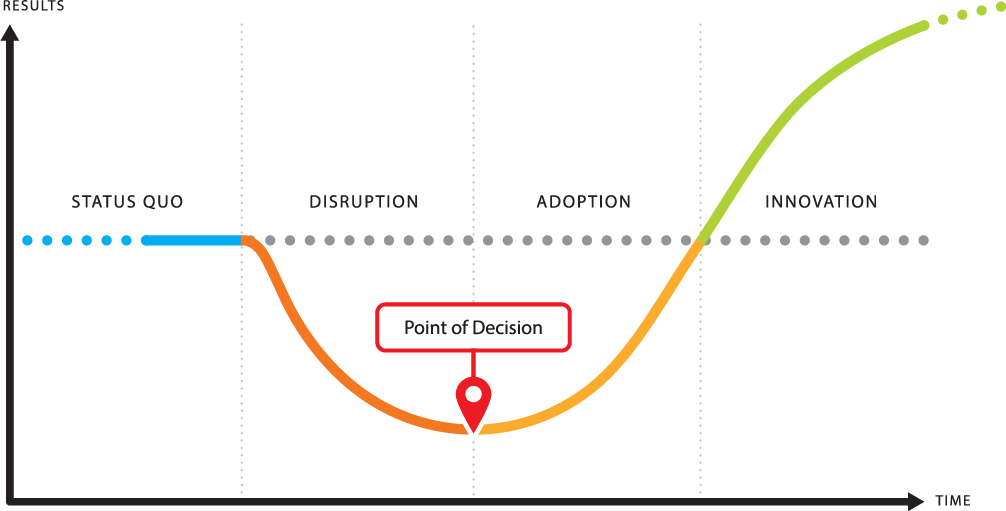
To achieve lasting success, several key elements are essential to organisational transformation. These include leadership buy-in, clear communication, and a culture of adaptability. Without support from the top, transformational efforts are unlikely to take root. Leaders must champion change by communicating a clear vision, inspiring teams, and creating accountability at every level—capabilities central to effective change leadership. Effective leaders also know how to successfully guide their teams through the challenges of the Change Model, from initial disruption to widespread adoption and innovation.
The Change Model
While every change is unique, there is a predictable pattern.
Learn more about Change: How to Turn Uncertainty Into Opportunity™
Additionally, alignment between leadership and culture is vital. For a transformation to succeed, it’s not enough to change strategies or introduce new technologies; organisations must ensure that their culture supports innovation, agility, and continuous improvement. For example, many companies that successfully transform their operations invest heavily in leadership development and cultural alignment.
Discover how The 6 Critical Practices for Leading a Team™ can change the game during organisational transformation.
Transformation vs. Traditional Change Management
Traditional change management typically focuses on incremental improvements such as refining processes or increasing efficiency within a department. Organisational transformation requires a broader shift that reaches across strategy, operations, culture, and customer relationships to reposition how the business performs.
Research indicates that organisations pursuing coordinated, multi-action transformations significantly outperform those relying on isolated improvements. Sustained transformation requires leaders to act proactively, define clear end outcomes, and align priorities and resources around the work that most directly advances those outcomes.
Unlike incremental change, transformation reflects a deliberate shift in how the organisation operates and executes against its most critical goals.
Common Causes of Organisational Transformation
There are several conditions that may lead to a need for an organisation’s transformation. These can stem from external factors outside the company’s direct influence or from internal challenges that the organisation needs to face head-on. Some common causes of business transformation are:
Growth
Whether a business is experiencing hypergrowth or has been building steadily over several years, it needs systems and a structure that can scale along with its growing needs. Both the structure of the organisation and the systems it relies on may need to undergo significant change to ensure the continued health of the business.
Globalisation and Market Expansion
As organisations extend into new markets on a national or international level, this may require a big shift in regulatory compliance, cultural development, or big-picture goals.
Acquisitions and Mergers
When one business is purchased by another or two organisations join forces to create a new entity, there may be sweeping changes that need to take place to move the company forward. These changes likely extend to the organisational structure, culture, and strategic initiatives.
Economic Changes
Whether linked to global economic shifts or a failure to meet financial targets, economic factors can lead to organisational transformation in the form of downsizing and layoffs. On the flipside, an economic boom could lead to expansion. In both scenarios, transformation is required as a result of major changes.
Technological Developments and Market Dynamics
Organisations have to keep up with rapidly changing technology and consumer demand. Whether in response to an emerging competitor, widespread tech adoption, or the development of innovative products, transformation may be a necessary step for the survival of the business.
Examples of Organisational Transformation
Organisational change and transformation can take many different forms, but transformation typically refers to seismic or significant changes that alter a business’s operations, mindset, culture, or vision moving forward. Some common organisational transformation examples can include:
- Mergers and acquisitions (M&A)
- Restructuring (i.e., department creation/mergers, downsizing/expansion, management hierarchy changes, etc.)
- Technological transformation (i.e., brick-and-mortar to e-commerce transitions, cloud-based or new software transitions, switch to AI-driven operations, etc.)
- Leadership changes (internal or external)
- Strategic transformation
- Cultural transformation
- Market expansion or product development
- Ordinance or regulatory changes
In many cases, the same transformation within one organisation can contain elements of several examples above and may not be strictly defined by or limited to a specific category.
5 Signs It’s Time to Consider an Organisational Transformation
With the common causes and examples of transformation in mind, how can leaders and executives know when it’s time to pursue a major change for their organisation? There’s no one-size-fits-all answer here, but it may be time to consider the possibilities if you’re seeing the following five signs.
1. Flailing Performance
Organisations that see significant drops in stock valuation or that have already undergone layoffs need to look inward, rather than blame flailing performance on external factors. While there are likely contributing factors outside your control, it’s important to focus on what’s in your Circle of Influence®, rather than on what’s in the Circle of Concern®. Learn more about Habit 1: Be Proactive and how it can help guide your organisation’s transformation.
2. Employee Churn
When you’re always having to replace star performers or top leaders, you can’t ignore the problem. Instead, you’ve got to figure out the root cause of employee churn, whether it’s an unsupportive culture, ineffective leadership, poor communication, a lack of connection and purpose, or a failure to keep up with market trends and care for your people. Rather than blame external factors, organisations need to take an honest assessment and have the courage to make impactful changes.
3. Ineffective Leadership
Even if your organisation isn’t yet experiencing a mass exodus, your leadership team’s effectiveness may require a more potent transformation, which could include anything from additional learning and development initiatives to potential leadership changes. If you’re dealing with negative reviews from former employees or teams with high performers are still missing the mark, it’s worth taking a closer look at whether your approach to leadership development needs extra attention.
4. Emerging Competition
Competition can light a fire under your organisation, but you need to make sure you don’t get burned. An established organisation needs to be in a good position to compete. But if innovation is at a standstill and you’re losing customers left and right, you’ll need to zero in on what’s not working and be willing to make changes to correct course.
5. Hypergrowth
While fast-paced growth may seem like an enviable problem to have, it can be disastrous for organisations that aren’t adequately prepared. The original structure and systems are often unable to scale quickly, which can lead to a devastating crash-and-burn effect. If your organisation has managed to tap into a rapidly growing segment of the market, you need to get the right systems and the right people in place now to meet demand and that may require some pretty big changes.
How Organisational Transformation Drives Innovation
Organisational transformation often creates the conditions that enable sustained innovation. As customer expectations, technology, and market conditions shift, organisations that adapt their strategy, operations, and ways of working are better positioned to test new ideas, learn quickly, and refine products and services. Some of the most well-known technology giants (like Google, Apple, and Amazon) excel at transformation. These companies maintain this advantage by experimenting, gathering customer feedback, and iterating rapidly, allowing them to introduce new solutions faster than competitors. This approach is not limited to large technology firms. When leaders create environments built on trust, open communication, and collaboration, teams are more willing to contribute ideas and solve problems together, helping organisations generate new solutions and maintain momentum during periods of transformation.
How to Implement Organisational Transformation
Successfully implementing organisational transformation is a complex process that requires meticulous planning, collaboration, and a deep commitment to cultural change. Unlike those smaller, incremental changes, transformation requires companies to realign their entire structure, operations, and strategy with their new business objectives. This holistic approach is vital to ensuring that transformation efforts are sustainable and effective. But because 70% of business transformation efforts fail, organisations need a solid plan to have theirs be among the coveted 30% of transformations that succeed.
What is Leadership’s Role in Organisational Transformation?
Leaders play a pivotal role in driving transformation within an organisation. Transformational leaders are not only strategic thinkers but also emotionally intelligent, resilient, and adaptable in the face of challenges. They must set the tone for the organisation, helping to foster a culture that embraces change rather than one that resists it.
The 4 Essential Roles of Leadership® become crystal clear during times of massive transformation. This framework helps leaders align their teams and stay ahead of the curve, especially against the backdrop of internal and external disruption.
To guide teams through organisational transformation, effective leaders must follow these practices.
Leaders Inspire Trust
Character and competence are foundational to building credibility. When leaders can demonstrate that they have integrity and good intent, while at the same time showing their capabilities and their results track record, they can often inspire trust in their teams. They also need to show they care for their people and that they want the best for everyone involved. When you build trust, you become a leader that others actively choose to follow.
Leaders Create Vision
As a leader, you need to help others understand the connection between individual contributions and the larger vision. Not only do leaders need to create a compelling vision that ties to the organisation’s biggest goals, but they must also connect that vision and those goals to a purpose that inspires teams to volunteer their best efforts and find meaning in their work. Develop your mission statement with our free mission statement builder tool.
Leaders Execute Strategy
Leaders need to know how to execute their strategy through every phase, with and through the involvement of other people. They also know that enduring success doesn’t stem from the strategy itself, but from the systems that they put in place to achieve their goals. Effective leaders understand the vital nature of developing a great system that aligns with the organisation’s most important aims and makes it easier for everyone to get the work done.
Leaders Coach Potential
The final role of a leader is to recognise and help develop leadership potential in others. By giving consistent feedback and coaching others on more effective leadership principles, leaders can transform their own leadership by empowering others, rather than simply telling their reports what to do.
How to Strategically Plan and Execute Organisational Transformation
Successful transformation requires disciplined focus on the work that most directly advances strategic outcomes. These four practices help leaders prioritise the right actions and sustain execution during periods of change.
1. Focus on the Wildly Important
Did you know that only 15% of employees know their organisation’s most important goals? When you fail to communicate the aims that really matter, your reports will have no chance of achieving them! And while you might have a lot you want to achieve, having too many goals risks diluting your results. Instead, you’ll need to focus on less to accomplish more. Selecting just one Wildly Important Goal® (WIG®) can allow you to narrow the focus and prioritise a crucial objective that won’t be accomplished during the regular day-to-day operational activities.
2. Act on the Lead Measures
Like it or not, 80% of your results will come from 20% of your activities—so focusing on the right activities is critical, especially during a transformative period. Because not all actions are created equal, leaders need visibility into how the work being done ultimately impacts the likelihood of achieving the goal. Lag measures—the metrics that track the success of your WIG and indicate whether that goal has been achieved—aren’t the only ones you need to pay attention to. Lead measures track the activities that drive the lag measures, meaning the things your team has direct influence over and that can predict the success of your WIG. Be sure to give attention to and act on the lead measures, which act as the lever that moves your Wildly Important Goal.
3. Keep a Compelling Scoreboard
People play the game differently when they’re keeping score. As a leader, you can use this psychological principle to propel results by developing and maintaining a scoreboard for your team. Even just a few simple graphs, showing the progress you’ve already made and how far you have left to go, can do the trick.
4. Create a Cadence of Accountability
While most of us have internal motivations to do good work and are accountable for our everyday behaviours, even the highest performers need systems in place to ensure metrics are being hit and that work is being completed efficiently. Establishing a regular process—a regular cadence—that covers successes, failures, and necessary course correction is vital for executing your strategy.
Training and Development for Organisational Transformation
Training and development enable employees to contribute effectively during organisational transformation. Beyond technical skills, organisations must strengthen leadership capability and individual effectiveness so people can adapt to new expectations, communicate clearly, and execute on changing priorities.
Development typically focuses on both leaders and individual contributors. Leaders strengthen capabilities such as leading change, building trust, managing teams, and maintaining execution through uncertainty. Individual contributors build skills in collaboration, communication, goal alignment, and time management so performance remains consistent as conditions evolve.
Sustained transformation also depends on culture. When organisations reinforce trust, encourage diverse perspectives, and support open collaboration, teams are more willing to contribute ideas and solve problems together, accelerating innovation during periods of change.
Learn how to build a winning culture during organisational change.
Looking to Transform Your Organisation? FranklinCovey Can Help
In today’s competitive business landscape, organisational transformation may not be optional—it’s often essential for businesses looking to thrive. By implementing transformation effectively and knowing how to properly navigate change, companies can drive innovation, manage risks, and build a culture of adaptability. With the right leadership, strategic planning, and a commitment to cultural alignment, transformation becomes a powerful tool for achieving long-term success.